

How to make important tasks feel less impossible
Some tasks are boring.
There is no clever reframe needed.
The form you need to complete. The email you keep avoiding. The spreadsheet that sits open on your laptop while you somehow find six other things to do. The life admin that is technically simple, but feels emotionally impossible. The report you know matters, but every time you open it, your brain seems to quietly leave the building.
And the most frustrating part is that these tasks are often important.
You know they matter. You know they would reduce stress. You know life would feel lighter once they were done. You know future-you would probably be grateful.
But still, your brain says:
No thanks.
For people with ADHD, this can be especially intense. But even if you do not have ADHD, you may recognise the same pattern. There are certain repetitive, dull-but-important tasks that seem to require an unreasonable amount of energy to start.
This is something I spoke about recently in my TEDx talk on ADHD and the interest-based brain.
I created a few characters to explain what is often happening underneath the surface.
One of those characters is:

The Administrator represents the world of slow, repetitive, predictable tasks.
Forms.
Reports.
Spreadsheets.
Policies.
Laundry.
Inbox management.
Filing.
Booking appointments.
Following up.
Doing the same process again and again.
The Administrator is not evil, exactly.
Annoyingly, The Administrator is often useful.
The Administrator keeps life moving. It pays invoices. It fills in forms. It remembers deadlines. It sorts the boring details that stop everything falling apart.
But for many ADHD brains, The Administrator is incredibly hard to listen to.
Not because the person is lazy. Not because they do not care. Not because they are incapable. But because the task gives the brain very little to engage with.
This is where a lot of normal productivity advice falls apart.
Most advice says:
“Just do it because it’s important.”
But importance does not always create activation.
You can know something is important and still feel completely stuck. You can care deeply about the outcome and still avoid the first step. You can be intelligent, capable and motivated in other areas of life, yet still feel blocked by a task that looks simple from the outside.
Dr William Dodson has described ADHD as being linked to an interest-based nervous system, where attention and action are more likely to switch on when there is interest, challenge, novelty or urgency involved, rather than importance alone.
That does not mean people with ADHD only do things they enjoy.
It means the brain often needs a stronger hook.
And that brings us to this week’s character.
Spark

Meet Spark
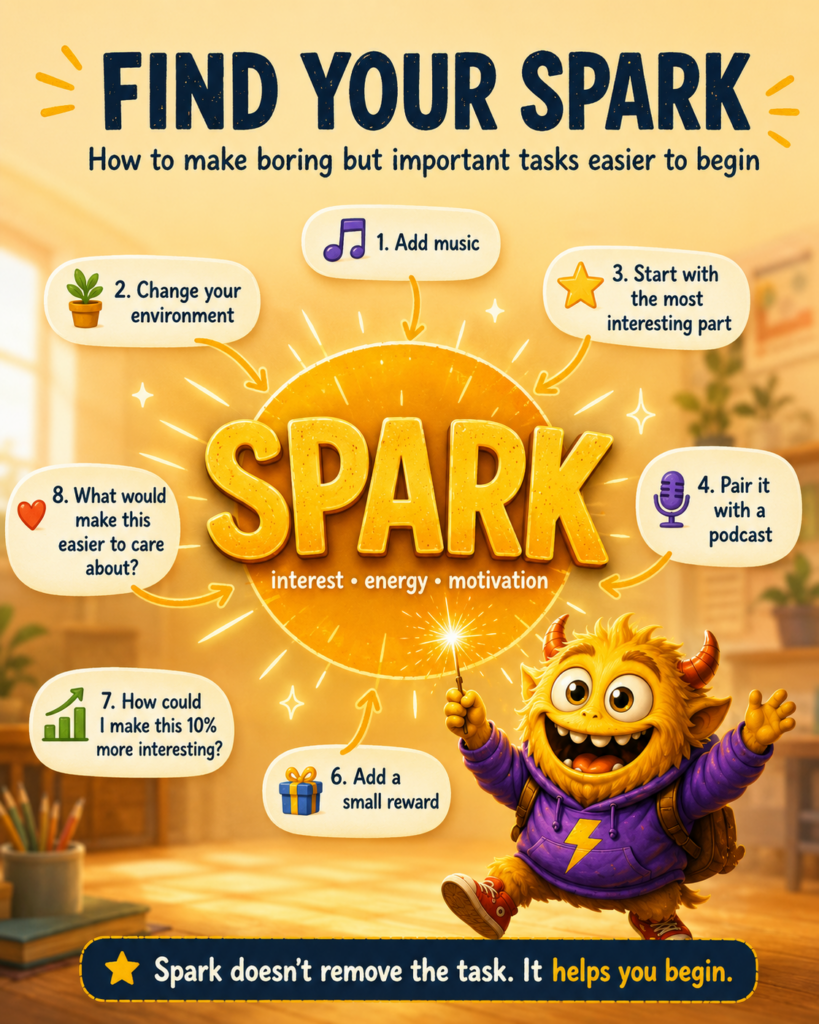
Spark is the part of you that lights up when something feels interesting.
Spark loves curiosity. Spark loves energy. Spark loves enjoyment. Spark loves the feeling of being drawn into something rather than dragged through it.
When Spark is present, tasks feel easier to begin.
You have probably experienced this.
You avoid a boring email all day, then suddenly spend two hours researching a random topic because it caught your attention.
You struggle to tidy the house, but if you put on a podcast you love, suddenly you can move.
You avoid writing something for weeks, but once you find the personal angle, the words start to come.
You put off planning your week, but when you use a notebook you actually like, some coloured pens, or a visual board, it becomes less painful.
That is Spark.
Spark does not remove the task.
Spark changes your relationship with the task.
And this is the key point:
You do not always need to make the task fun.
That is too much pressure.
You just need to make it more interesting than it currently is.
A boring task does not need to become exciting. It may just need to become 10% more engaging, 10% more personal, 10% more connected to something you already care about.
Sometimes that is enough to begin.
How to Add Spark to Boring Tasks
The question is not:
“How do I force myself to care?”
The better question is:
“How can I connect this task to something that already interests me?”
Let’s make that practical.
If emails feel boring, you could create an “email walk” where you read through messages while walking slowly around the house or garden, then return to your desk just to send the replies. Or you could create a playlist that only plays when you are clearing your inbox. Or you could treat the task like a communication challenge: “How can I make this reply clearer, kinder or more useful in half the words?”
If planning your week feels dull, you could make it more visual. Use a whiteboard. Use sticky notes. Use colours. Draw boxes. Make it feel less like admin and more like designing the next few days. Some people with ADHD respond much better when they can see the week rather than hold it all in their head.
If tidying feels repetitive, Spark might come from pairing it with something you enjoy. A podcast. An audiobook. A playlist that gives you energy. A timer where you try to improve the room for one song only. You are not trying to become someone who loves tidying. You are simply giving your brain something else to hold onto while your body gets moving.
If writing a report feels dry, do not start with the most boring section. Start with the part you have the most opinion about. Start with the problem. Start with the recommendation. Start with the one paragraph you can actually explain to another human being. Once Spark is in the room, the more formal parts often become easier to complete afterwards.
If invoices, receipts or bookkeeping feel painful, build a ritual around them. Same drink. Same time. Same playlist. Same 25-minute sprint. Same small reward afterwards. The Spark might not come from the task itself. It might come from making the experience around the task more pleasant and predictable.
If exercise feels boring, connect it to something that already interests you. Boxing, dancing, walking somewhere beautiful, listening to a great audiobook, training with a friend, tracking a skill, or turning it into a challenge. The goal is not simply “exercise more”. The goal is to find the version of movement your brain is more willing to return to.
If you are doing coursework, client notes or reflective writing, Spark might come from changing the starting question. Instead of “What do I need to write?”, ask “What was actually interesting here?” or “What did I notice that surprised me?” or “What would I explain to someone else if they were struggling with this?” Interest often appears when the task becomes connected to real insight.
This is especially important for ADHD brains because boring tasks can quickly become shame tasks.
The task starts as “reply to email”.
Then it becomes:
“Why haven’t I done this?”
“What’s wrong with me?”
“I’m so behind.”
“They probably think I’m rude.”
“I always do this.”
Now the task is not just boring.
It is emotionally loaded.
Spark helps because it gives you a different doorway into the task. Instead of trying to push through shame, you create a more inviting route in.
A Simple Spark Question
When you are stuck, ask yourself:
“What would make this task easier to care about for the next ten minutes?”
Not forever.
Not for the whole afternoon.
Just for the next ten minutes.
That question is powerful because it lowers the bar.
You might realise you need music.
You might need to move rooms.
You might need to start with the most interesting part.
You might need to make it visual.
You might need to talk it through with someone.
You might need to connect it to a bigger reason.
You might need to make the first step smaller.
You might need to add a little reward.
Spark is not always dramatic.
Sometimes Spark is just enough energy to get started.
And for many people, starting is the real battle.
Your Spark Challenge This Week
Choose one boring but important task you have been avoiding.
Then ask:
“How can I add more Spark to this?”
Try one small change.
Add music.
Add movement.
Add a podcast.
Add colour.
Add a better environment.
Add a personal reason.
Add a more interesting starting point.
Add a small reward.
Add a bit of curiosity.
Add a way to make the task feel more human.
Do not aim to make the task perfect.
Do not wait until you feel fully motivated.
Just add enough Spark to begin.
Because you do not need to become The Administrator.
You may just need to bring Spark into the room.
Ready to Take the Next Step?
If you’re exploring ADHD coaching in the UK, the next step is simply to start a conversation.
At SPEAKup Challenge, we support adults, professionals and aspiring ADHD coaches with practical, strengths-based support.
You can:
- Explore ADHD coaching
- Learn about Access to Work support
- Discover ADHD coach training opportunities
👉 Book onto our upcoming ADHD coaching diploma day to explore whether ADHD coaching could support your goals.


Leave a Reply
You must be logged in to post a comment.