

If you’re a coach (especially early in your journey), you’ll recognise this moment.
A client starts talking about a challenge — maybe it’s procrastination, confidence, or a messy situation at work.
You listen.
For a few seconds.
Then something clicks.
“Ah… I know what they should do here.”
And suddenly, you’re not really listening anymore. You’re waiting for your turn to speak.
You jump in. You offer an idea. You try to help.
The client nods politely. Maybe they even say, “Yeah, that makes sense.”
And yet… nothing really changes.
🎥 Watch the original TEDx talk
If you haven’t seen it, this is worth your time:
How to Tame Your Advice Monster – Michael Bungay Stanier
https://www.youtube.com/watch?v=Kl0rmx7aa0w
The Moment I Realised I Wasn’t Coaching
I remember early on in my coaching journey, I had a client who kept talking about struggling with consistency.
Classic coaching scenario.
They explained their week. The missed gym sessions. The distraction. The frustration.
And in my head, I was on fire:
- “They need a better routine.”
- “They should track their habits.”
- “They just need accountability.”
So I jumped in.
I gave them a clear, structured plan. Honestly — it was pretty good.
They agreed. They said it sounded helpful.
Next session?
Nothing had changed.
At the time, I thought:
“They just didn’t follow through.”
Looking back, I see it differently:
👉 I solved a problem they hadn’t fully understood themselves.
👉 I removed their ownership.
👉 I did the thinking for them.
That’s the Advice Monster in action.
What is the Advice Monster (Really)?
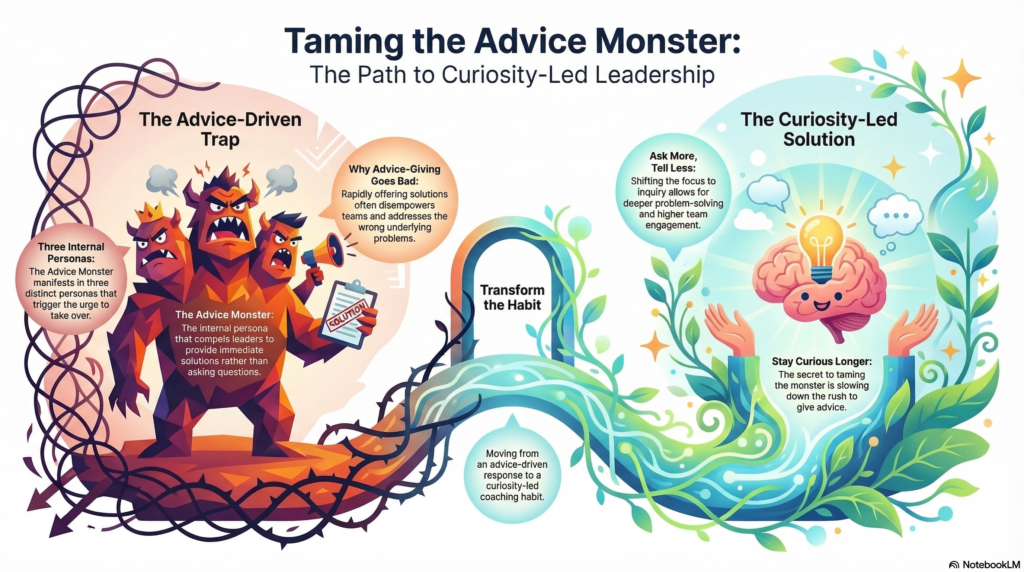
The Advice Monster — a concept popularised by Michael Bungay Stanier — is our instinct to jump in with solutions before we’ve earned the right to.
It’s not just a coaching issue.
It’s a human issue.
Research from Harvard Business School shows that people consistently overestimate the value of their advice and underestimate how much others want to feel understood first. In one study, advisors believed their input would be highly valued — but recipients reported feeling less satisfied and less empowered when advice came too quickly.
So this isn’t just theory.
There’s a real psychological cost to “helping too fast.”
Why It Feels So Right (But Goes So Wrong)
Let’s give the Advice Monster some credit.
It’s not evil. It’s trying to help you.
1. You Want to Add Value
As a coach, you feel a subtle pressure:
“If I don’t say something useful, what am I even doing here?”
So you reach for something tangible — advice feels like value.
But here’s the shift:
👉 In coaching, value is not what you say. It’s what the client realises.
2. Silence Feels Awkward
There’s a moment in coaching where the client stops talking.
And your brain goes:
“This is awkward. Fix it.”
So you do.
But studies in counselling and coaching psychology show that allowing even 3–5 seconds of silence increases depth of reflection and insight.
What feels awkward to you… is often productive for them.
3. You Mistake Speed for Effectiveness
Advice is fast.
Questions take time.
But behaviour change? That’s slow.
Research in behavioural psychology consistently shows that self-generated solutions are significantly more likely to be acted on than externally imposed ones. This is tied to something called the self-determination theory — people are more motivated when they feel autonomy, competence, and ownership.
Advice kills that.
The Real Cost: You Disempower the Client
This is where it matters most.
When you jump in with advice, you subtly communicate:
“I’ve got this. Let me take over.”
Even if you don’t say it like that.
Over time, this creates a dangerous dynamic:
- The client looks to you for answers
- You feel pressure to provide them
- The client becomes dependent
- Progress slows
A study published in the Journal of Applied Psychology found that employees who were frequently given direct solutions by managers showed lower problem-solving ability over time compared to those who were coached through challenges.
Same principle applies here.
👉 Advice builds short-term relief. Coaching builds long-term capability.
If the Roles Were Reversed…
Let’s ground this.
Imagine you’re overwhelmed in your business.
You sit down with someone and start explaining what’s going on.
Halfway through, they interrupt:
“You know what you should do…”
They give you a neat, tidy solution.
How do you feel?
- Slightly dismissed?
- Not fully heard?
- Maybe even a bit resistant?
Now imagine instead they say:
“What feels like the hardest part of this for you?”
And then…
They actually listen.
They stay with you.
They help you figure it out.
That’s the difference.
👉 One creates compliance.
👉 The other creates ownership.
The Three Faces of Your Advice Monster
Your Advice Monster isn’t random. It usually shows up in one of three ways:
🗣️ The Tell-It
You believe your value comes from having the answer.
You want to sound smart. Capable. Helpful.
🛟 The Save-It
You hate seeing clients struggle.
So you step in too early — not for them, but to relieve your own discomfort.
🎮 The Control-It
You steer the session.
You subtly direct where things go instead of trusting the process.
Here’s the uncomfortable truth:
👉 All three are more about you than the client.
The Shift That Changes Everything
You don’t need to become a silent monk.
You just need to shift one thing:
Stay curious a little longer.
That’s it.
Not forever.
Just longer than feels natural.
Because that extra space is where:
- The real problem emerges
- The client connects the dots
- Ownership is built
A Better Way to Show Up in Sessions
Let’s make this practical.
Instead of jumping in with:
“Have you tried…?”
Try staying in curiosity:
“What’s the real challenge here for you?”
And then — this is key — follow it with:
“What else?”
Research from coaching frameworks (including ICF-aligned approaches) shows that layered questioning significantly increases depth of insight, often uncovering root issues within 2–3 follow-up questions.
Most coaches stop too early.
Final Thought: The Paradox of Helping
Here’s the irony that every coach eventually faces:
👉 The more you try to help by giving advice, the less effective you become.
And the more you step back, stay curious, and trust the client…
👉 The more powerful your coaching becomes.
So next time you feel that urge — that little voice saying:
“Jump in. Fix it. Help them.”
Pause.
That’s not your coaching instinct.
That’s your Advice Monster.
And your client?
They don’t need a fixer.
They need someone who believes they can figure it out.
Ready to Take the Next Step?
If you’re exploring ADHD coaching in the UK, the next step is simply to start a conversation.
At SPEAKup Challenge, we support adults, professionals and aspiring ADHD coaches with practical, strengths-based support.
You can:
- Explore ADHD coaching
- Learn about Access to Work support
- Discover ADHD coach training opportunities
👉 Book onto our upcoming ADHD coaching diploma day to explore whether ADHD coaching could support your goals.



Leave a Reply
You must be logged in to post a comment.