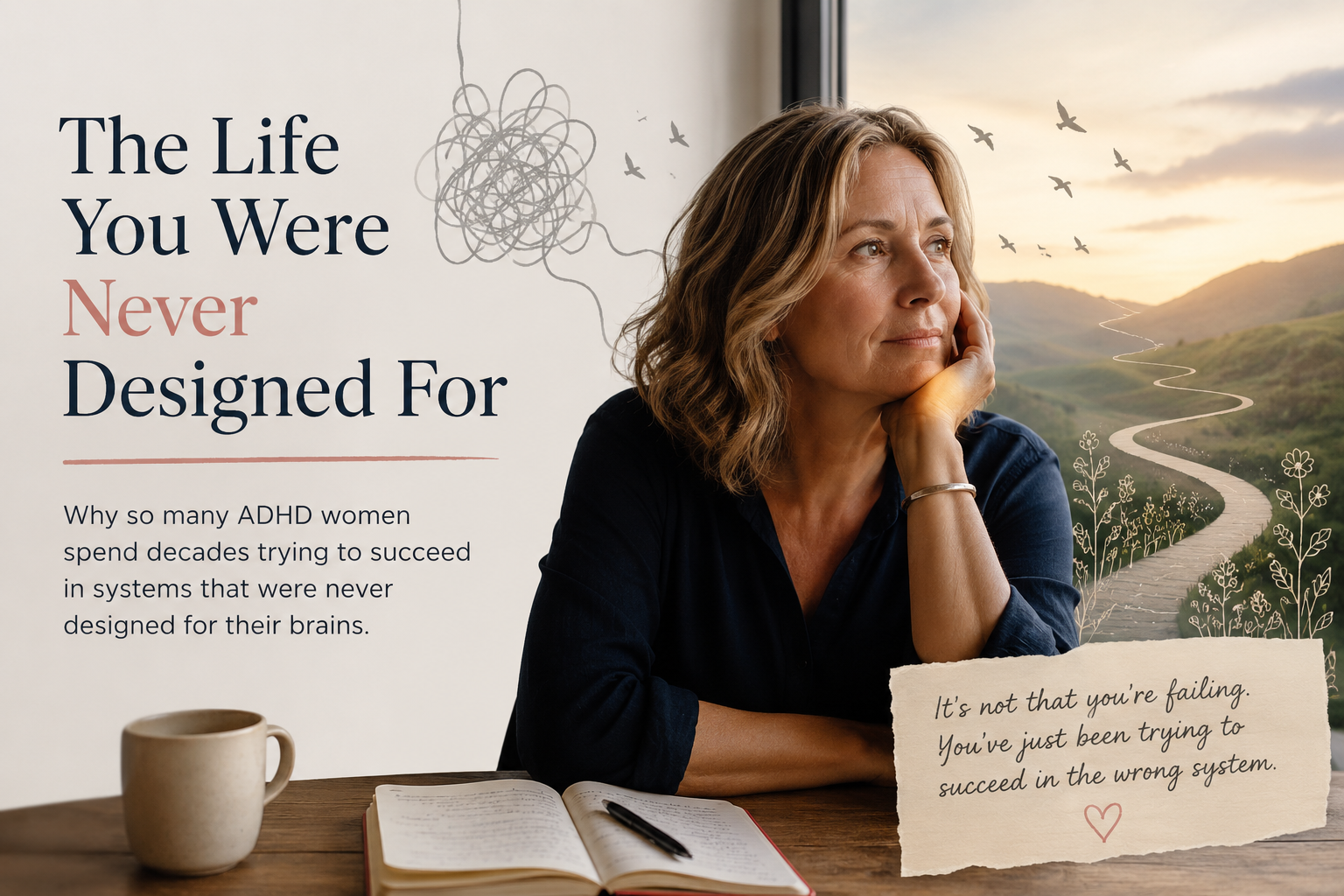

The Scene You Know All Too Well
You finally sit in your car after another long day of helping everyone else. The school report was glowing, your patient left smiling, your client felt heard. You hold space, solve crises and remember everyone’s details. But your own tasks – the permission slip somewhere in the bottom of your bag, the unopened bill on the kitchen table, the laundry you left in the machine (again) – feel like mountains. You check your phone for the fourth time because you’re sure you forgot something, yet you can’t recall what. You replay a teacher’s comment from thirty years ago about “not applying yourself.” It stings even now. You wonder why your brain can handle emergency calls but freezes when it’s time to fill out a form.
If this feels uncomfortably familiar, you’re not alone. Many women who keep families, schools, hospitals and social services running have spent decades carrying invisible weights. They look competent on the outside but feel chaotic on the inside. This newsletter is for you.
Story – Claire’s Life in Three Acts
Act I: Doing All the Things
Claire, 48, has been a high school teacher for twenty years. She remembers every student’s name, loves designing lessons and is the colleague everyone calls when there’s a crisis. She also misplaces her keys daily, forgets her own lunch and leaves household paperwork until late at night. As a child she was told she was “bright but lazy,” and she believed it. She made lists, apologised for lateness and assumed everyone else found life easier.
Act II: The Breaking Point
Midway through her forties, Claire’s workload increased. Her parents needed more support, her teenage son was diagnosed with ADHD, and the school introduced a new admin system. She spent nights filling forms and weekends catching up on laundry. When her son’s psychologist casually asked if she had ever been assessed, something clicked. For the first time, she wondered: “What if this isn’t about me being disorganised? What if my brain is wired differently?”
Act III: A New Lens
Claire’s diagnosis at 47 triggered a rush of relief, grief and anger. Relief, because decades of hidden struggle now had a name. Grief, for the years spent believing she was broken. Anger, because so many adults missed the signs. But slowly, curiosity and self-compassion emerged. She realised she had built a meaningful life despite a constant mismatch between her brain and the systems around her. Her journey mirrors that of thousands of late‑diagnosed women who are now re-reading their past with compassion and looking at midlife as a chance to build something better.
Reframe – It Wasn’t Failure; It Was Mismatch
The research is clear: ADHD is recognised less often in girls and women because inattentive symptoms are easier to miss. Many women are first diagnosed when adult responsibilities overwhelm coping strategies. For years you tried to thrive in environments that rewarded sustained attention, time estimation, routine sequencing and frictionless administration – precisely the areas ADHD makes hardest. Schools praised tidy notebooks over creative connections. Workplaces rewarded punctual paperwork over crisis management. Motherhood demanded invisible cognitive labor – lists, appointments, snack planning – that felt like manual breathing. When you struggled, you assumed it was a moral failing.
What if you never lacked discipline? What if ordinary life was simply built around strengths that weren’t yours? This isn’t about blaming society or ignoring responsibility. It’s about recognising that you have been carrying more cognitive and emotional weight than anyone saw.
Psychology – Why It Happened
Multiple national health authorities note that girls’ ADHD symptoms – distractibility, forgetfulness, difficulty organising time, restlessness and impulsive decisions – are often misread as personality traits. Adult women may have been supported by structured environments in childhood, masking impairment. When those scaffolds fall away, stresses exceed coping ability and symptoms surface. In England alone, there may be 2.5 million people with ADHD, yet only 800 000 have a formal diagnosis. Demand for support far exceeds provision; waiting lists were around 549 000 in March 2025. Diagnosis rates are soaring among women aged 25–34, meaning many are only now discovering why life felt harder than it looked.
Burnout research adds another layer: meaningful work can buffer stress, but over‑engagement without rest backfires. Helping professionals often sacrifice recovery for duty, leading to compassion fatigue. Midlife psychology studies show that ages 40–60 are not inherently crises – they can be periods of growth, contribution and renewed direction. The emotional sequence after diagnosis – relief, grief, anger, curiosity – makes sense: you are processing lost years while glimpsing future possibilities.
Compensation Isn’t Fit
Perhaps the most powerful insight from the research is this: compensation is not the same as fit. You might be intelligent, conscientious, caring and even successful, yet still be mismatched to the systems you inhabit. Living on the edge of deadlines, making endless lists and staying up late to “catch up” are not personal flaws – they are creative workarounds. Over time, they take a toll. Recognising that distinction doesn’t absolve you of responsibility, but it does free you from shame.
Questions & Actions
This is where understanding turns into redesign. Before you jump to productivity hacks, pause. Ask yourself:
- Which parts of your life have always felt like manual breathing? (Where you’ve needed constant conscious effort.)
- Which successes cost you more than anyone could see? (What did it take to appear competent?)
- Where have you been over‑compensating to mask disorganisation or time blindness?
- Which environments made you feel calm and focused, and which amplified chaos?
- What unspoken rules have you tried to follow that never made sense to you?
As you explore, consider these three realistic actions for the coming week:
- Redesign Your Environment: Identify one administrative task that drains you and set up external scaffolding. This might mean asking for written instructions at work, blocking out a quiet space or using a shared calendar with reminders. The NHS specifically recommends written instructions, quiet spaces and help structuring tasks for adults waiting for formal support.
- Experiment with Body Doubling or Co‑Working: Research shows that having a “body double” – someone working alongside you virtually or in person – can increase focus and task completion. Schedule one session with a friend or colleague where you both work silently on your own tasks.
- Practice Self‑Compassion: A meta‑analysis in Health Psychology links self‑compassion with better sleep, healthier habits and less stress. Each time you miss a deadline or misplace something this week, notice the urge to self‑criticise and instead respond as you would to a dear friend: with understanding and curiosity rather than blame.
These are small, achievable steps. They don’t require a diagnosis or expensive tools. They work with your brain rather than against it.
Hopeful Future – Midlife as an Honest Beginning
Diagnosis doesn’t change your brain, but it does change your story. Midlife can be the first era where you stop organizing your life around hiding. The research points out that midlife is often miscast as decline; it can be a period of growth and possibility. Thousands of women are now re‑imagining work, relationships and purpose. Some are exploring coaching, with the International Coaching Federation reporting 122 974 practitioners worldwide and a rapidly growing industry. Others are redefining success on their own terms. Whether or not you pursue coaching or a new career, the next chapter is about fit, not performance.
Imagine designing a daily rhythm that honours your strengths – creativity, crisis thinking, empathy, hyperfocus on interests – while outsourcing or structuring the tasks that drain you. Imagine saying no because your energy is not infinite. Imagine choosing roles that use your brilliance without punishing your differences. It’s not a fantasy; it’s a design question. And it starts with the recognition that you were never designed for the life you were forced to lead. Now you get to build one that fits.
Action Step – Your Invitation
Choose one of the reflection questions and one action from the list above. Write a few sentences about how they relate to your life. Share your thoughts with someone who understands, or reply to this email if you’d like to connect. This is how redesign begins: not with grand plans, but with honest experiments.
Reflection Exercise (Five Questions)
- Where have I felt pressure to “act normal,” and what did that cost me?
- What systems (school, work, family) felt like they rewarded everything I struggle with?
- Which hidden strengths have helped me survive despite those mismatches?
- What new boundaries could reduce the emotional and cognitive cost of my current life?
- How might my life look if I designed it around my brain rather than around expectations?
Ready to Take the Next Step?
If you’re exploring ADHD coaching in the UK, the next step is simply to start a conversation.
At SPEAKup Challenge, we support adults, professionals and aspiring ADHD coaches with practical, strengths-based support.
You can:
- Explore ADHD coaching
- Learn about Access to Work support
- Discover ADHD coach training opportunities
👉 Book onto our upcoming ADHD coaching diploma day to explore whether ADHD coaching could support your goals.


Leave a Reply
You must be logged in to post a comment.